US Sales Tax for SaaS Founders
18 May 2026
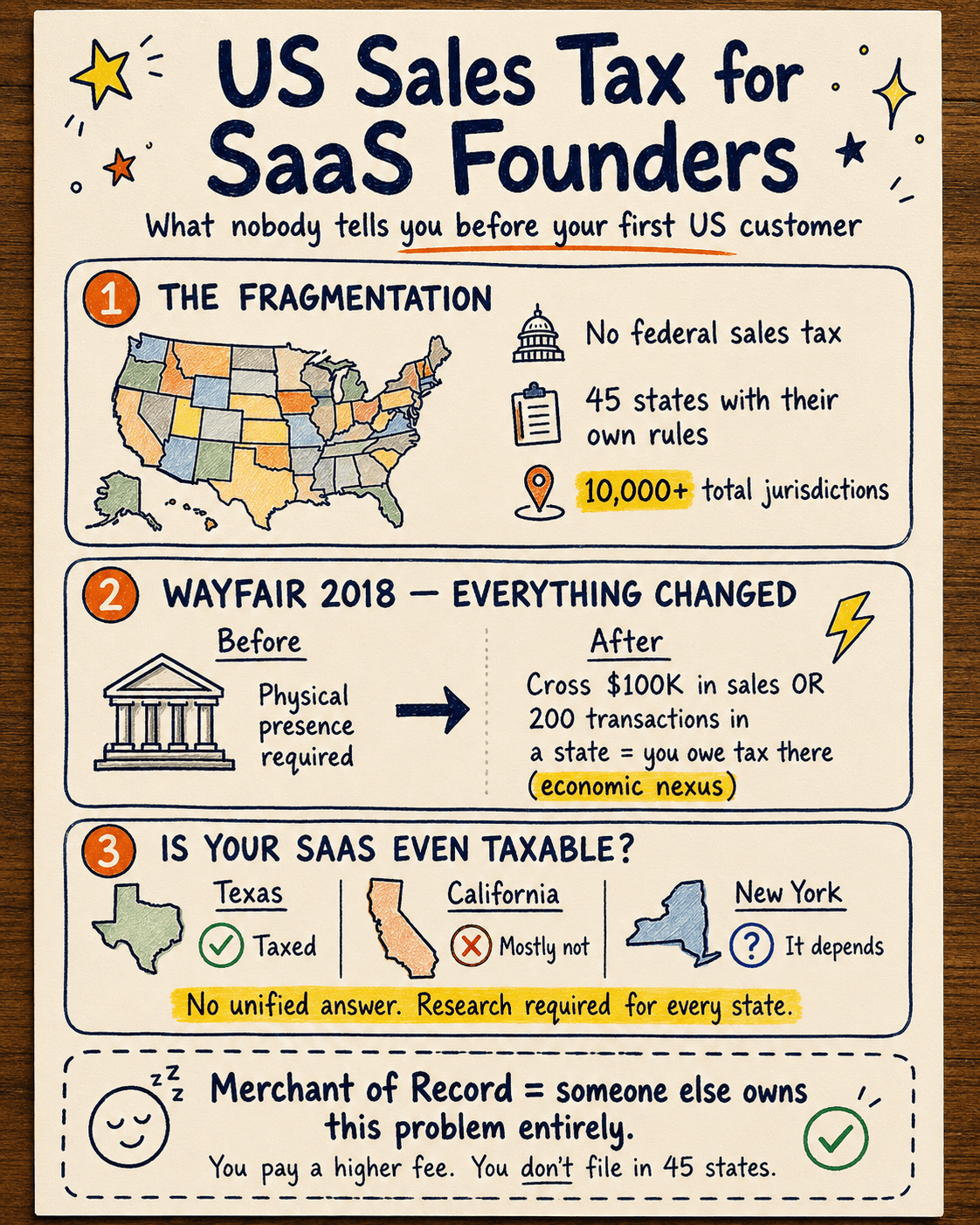
You just got your first US customers. Congratulations.
You now owe sales tax in states you have probably never heard of.
The US has no federal sales tax. Instead, there is a complex patchwork of 45 state-level systems, each with its own rates, exemptions, rules, and filing schedules — on top of thousands of county and city jurisdictions. In total, there are over 10,000 distinct taxing authorities.
Physical presence used to be the rule
For most of the web's history, a foreign company only owed US sales tax where it had physical presence: an office, a warehouse, an employee. If you were building SaaS from Europe and selling to American customers with no US presence, you were largely off the hook.
That changed in 2018.
South Dakota v. Wayfair
The Supreme Court's South Dakota v. Wayfair decision established a new standard: economic nexus. The logic is straightforward — if a company derives significant economic benefit from a state, it should participate in that state's tax system, regardless of where it is physically located.
What counts as "significant" varies by state, but the most common thresholds are $100,000 in annual sales or 200 transactions into a state. Cross either one and you become liable for collecting and remitting sales tax there. Every state with a sales tax has adopted some form of economic nexus since the ruling.
The implication for international SaaS founders is significant: your first $100K quarter in the US might trigger tax obligations across multiple states simultaneously — whether you knew about them or not.
Is your SaaS even taxable?
Here is where it gets genuinely confusing.
The assumption many founders make is that once they understand nexus, they understand their obligations. But determining nexus is only step one. Step two is determining whether your specific product is even subject to sales tax in each state where you have nexus.
The answer is not consistent. Texas taxes SaaS. California largely does not. New York taxes it in some cases but not others, depending on how the product is classified. Florida recently started taxing certain digital services. There is no federal standard, no shared taxonomy, no lookup table you can trust across all states.
For a European founder accustomed to VAT — a single harmonized framework that works the same way across 27 countries — this is disorienting. VAT has a defined concept of "place of supply" and clear B2B/B2C distinctions. US sales tax has neither at the federal level.
Why Merchant of Record exists
This is exactly the problem Merchant of Record (MoR) platforms like LemonSqueezy, Paddle, or Gumroad are designed to solve.
When you sell through a MoR, the platform becomes the legal seller of record. You receive a payout after they take their cut. In exchange, the MoR assumes full responsibility for sales tax determination, collection, filing, and liability across all US states — and often globally.
You pay a higher processing fee. But you don't need to register in 45 states, track nexus thresholds in each one, research taxability rules for your product category, file quarterly returns, or respond to state tax notices. Someone else owns the problem entirely.
Whether it is worth it
The trade-off depends on a few variables: your transaction volume, your average order value, how concentrated your US customers are geographically, and how much operational overhead you are willing to absorb.
At low volumes, the higher MoR fee is almost always worth it. The cost of the expertise, tooling (services like TaxJar or Avalara), and time required to manage sales tax compliance yourself exceeds the fee differential by a significant margin.
At scale, the math shifts. A company processing millions in annual US revenue might find it more efficient to manage compliance directly or through dedicated tax counsel. But most SaaS companies with their first US customers are nowhere near that inflection point.
The question worth asking before your first $100K quarter in the US is not just how to collect sales tax. It is whether you want to own that complexity at all — and what it would cost you not to.