Anatomy of a LiPE
29 March 2026
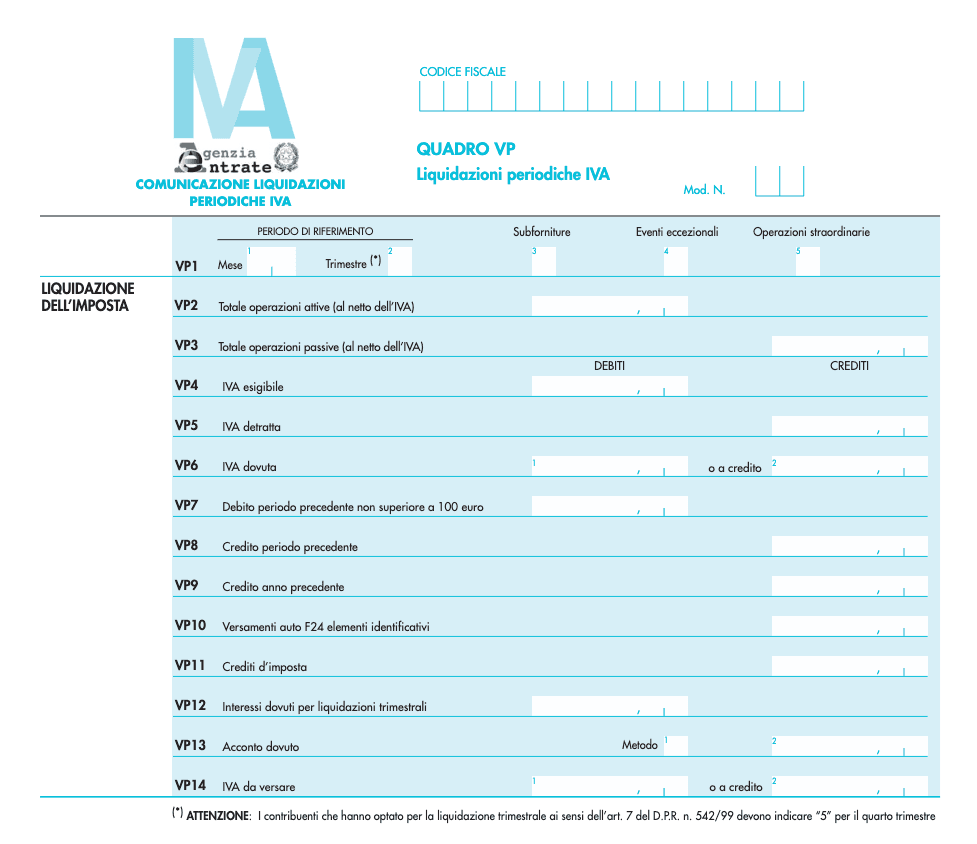
Four times a year, every Italian VAT-registered business in the standard regime sends the tax authority (Agenzia delle Entrate) an XML file summarising their VAT position for the quarter just ended. It's called LiPE — Comunicazione delle Liquidazioni Periodiche IVA, or Periodic VAT Settlement Communication — and it's been mandatory since 2017.
Like the FatturaPA format, it's a structure that tells you more than it first appears. It's worth opening it and reading it field by field.
Who files it and who doesn't
The obligation applies to all VAT-registered entities that perform periodic settlements. Exempt are those who don't charge VAT: the flat-rate regime (forfettario, RF19), the minimum taxpayer regime, and some special categories like simplified agricultural producers.
The forfettario is exempt because they don't add VAT to their invoices and can't reclaim it on purchases — there's nothing to settle. For everyone else, the LiPE is how the state monitors in near real-time that VAT is being correctly calculated and paid.
The VP section
The core of the form is the quadro VP — a module filled in once per period. Quarterly filers complete one module per quarter; monthly filers (those above the turnover threshold) complete three modules per quarter, one for each month.
The fields run from VP1 to VP14.
VP1 — The period
Indicates the month (1–12) or quarter (1–4) the module refers to. It's what distinguishes modules when a single submission contains more than one.
VP2 and VP3 — The transactions
VP2 is total active transactions net of VAT: all sales, services, supplies — taxable, exempt, non-taxable, reverse charge, split payment. Not the VAT itself — the aggregated tax base.
VP3 is total passive transactions: purchases of goods and services, imports, intra-EU operations. Again, net of VAT.
The distinction between VP2/VP3 and VP4/VP5 matters: VP2 and VP3 are volumes, VP4 and VP5 are taxes.
VP4 and VP5 — The VAT
VP4 is output VAT: the total VAT you've become liable for during the period — the VAT on your sales where liability has materialised.
VP5 is input VAT: the total VAT you can reclaim on purchases registered during the period.
VP6 — The period balance
VP6 is the difference between VP4 and VP5:
- If VP4 > VP5: VAT owed (column 1)
- If VP5 > VP4: VAT credit (column 2)
It's the raw result of the settlement, before corrections and carryforwards from previous periods.
VP7 and VP8 — Carryforwards
VP7 is the debt from the previous period that wasn't paid because it fell below the minimum threshold. Since 2024 — following the D.Lgs. 1/2024 simplification decree — this threshold was raised from €25.82 to €100: if the VAT owed is less than one hundred euros, payment rolls to the next period and the amount goes into VP7. It's an anti-fragmentation mechanism: paying €8 every month makes no sense for anyone.
VP8 is the credit from the previous period. If the final result last quarter was a credit, that amount carries here. VP8 is populated from VP14 column 2 of the previous period, net of any amounts already offset via F24 tax payment form.
VP9 — Prior-year credit
Different from VP8: this is the VAT credit from the previous year's annual declaration, if you're carrying it forward through the current year rather than requesting a refund. It's a structural reduction, not a quarterly carryforward.
VP10, VP11 — Special items
VP10 relates to payments for the first domestic resale of vehicles previously purchased intra-EU — a very specific provision that applies to few.
VP11 is special tax credits from legislative incentives, used to offset the payment. It doesn't include credits offset via F24, which don't flow through the LiPE.
VP12 — The 1% interest
This field only exists for quarterly filers, and it explains why the monthly/quarterly distinction matters.
Monthly filers pay VAT by the 16th of the following month. Quarterly filers benefit from an effective deferral — they pay in a single instalment every three months. To compensate for this financial advantage, quarterly filers apply a 1% surcharge on net VAT owed for each quarter.
VP12 is not filled for Q4, because the October–December settlement flows into the annual declaration with its own rules.
VP13 — The December advance
In December, by the 27th, many taxpayers pay a VAT advance. VP13 holds this amount, which is then deducted from the final result. The obligation threshold is €103.29: below this, no advance is due.
VP14 — The result
VP14 is the final field:
VAT to pay =
  (VP6 col.1 + VP7 + VP12)
  −
  (VP6 col.2 + VP8 + VP9 + VP10 + VP11 + VP13)
If positive it goes in column 1 (to pay). If negative it goes in column 2 (credit, carried into VP8 of the next period).
Payment, if due, is made via F24 form by the quarter's deadline. If the result is a credit, nothing is paid and the credit accumulates.
Deadlines
Deadlines are fixed, shifted to the next Monday if they fall on a weekend or holiday:
| Quarter | Period | Standard deadline | |---|---|---| | Q1 | January–March | 31 May | | Q2 | April–June | 16 September | | Q3 | July–September | 30 November | | Q4 | October–December | Last day of February |
Q4 has one peculiarity: if the annual VAT declaration is submitted by February, the Q4 data can be folded directly into the VP section of the annual declaration, avoiding a separate LiPE submission. An optimisation accountants often use.
How it's filed
Submission is exclusively electronic, via the Fatture e Corrispettivi portal of the Agenzia delle Entrate — the same place where received e-invoices are viewed. The guided online form is sufficient for most cases; those using accounting software can upload the XML file directly.
The format is XML, with technical specifications published by the AdE in 2018 and updated periodically.
What the structure reveals
The LiPE is a form designed for reconciliation. Every field is meant to be cross-referenced against other data: VP2 active transactions must be consistent with invoices issued in the VAT register; VP4 must match the VAT shown on those invoices; VP8 must reflect VP14 from the previous quarter.
It's not a simple form to fill in: it's a declaration the state can verify automatically by comparing it against electronic invoices that have already transited the SDI system. Since e-invoicing became mandatory (2019 for most taxpayers), the AdE already knows most of the data that feeds into a LiPE before you even submit it. The form has shifted from an informational obligation to a formal confirmation.
This article is informational. For your specific tax situation, consult a qualified accountant.